★★★★★
3/5
Peptide Sciences was one of the largest and most recognizable research peptide suppliers in the United States. For years, it sold a huge catalog of research compounds and built a reputation around high purity claims, batch-specific testing, fast domestic shipping, and an extensive selection.
That changed in March 2026.
Peptide Sciences has shut down and is no longer selling research products. Its official website now displays a closure notice rather than an active storefront, and the company specifically warns that websites or businesses claiming to be successors to Peptide Sciences are unauthorized.
I also personally ordered from Peptide Sciences before it closed. My experience involved an AOD-9604 order that arrived quickly but ultimately turned into a frustrating dispute over a vial that looked unusual when I opened the package.
This updated Peptide Sciences review covers what happened to the company, whether it was legitimate while operating, its testing history, my firsthand ordering experience, and what former customers should know now that Peptide Sciences is closed.
Peptide Sciences Review: Quick Summary
Current status:
- Company status: Closed
- Closure: March 2026
- Can you currently order? No
- Official website: PeptideSciences.com remains online primarily to display the shutdown notice
- Official successor: None announced
- My personal experience: Mixed to negative
- Product I ordered: AOD-9604
- Historical strengths: Large catalog, fast shipping, extensive testing documentation
- Historical drawbacks: Premium pricing, strict return policy, and—in my case—poor handling of a product complaint
What I liked:
- One of the largest peptide catalogs available at the time
- Established company with years of operating history
- My order shipped and arrived quickly
- Batch-specific testing and COAs were a major part of the company’s reputation
- Large selection of individual peptides and peptide combinations
- Historically easy to order from compared with many smaller research suppliers
What I didn’t like:
- My AOD-9604 vial arrived with an unusual cloudy appearance
- Customer service initially refused to accept my return
- I had to exchange several emails before they agreed to take the product back
- My original shipping charge was not refunded
- I also had to pay return postage
- Independent testing shows that quality results were not equally strong across every Peptide Sciences product
- The company is now permanently unavailable as a supplier unless it announces otherwise
Bottom line: Peptide Sciences was a real, established research peptide company, but it is no longer operating. My own ordering experience was disappointing enough that I had already decided not to purchase from the company again before it closed.
Peptide Sciences is no longer accepting orders. If you’re looking for another supplier, see our updated guide to the best Peptide Sciences alternatives for 2026.
⚖️ Looking for a Peptide Sciences Alternative?
Peptide Sciences had a long history in the research peptide market, but the company is no longer operating. If you’re looking for a current supplier, see how today’s top-rated peptide companies compare on testing, pricing, product selection, and reputation.
Is Peptide Sciences Still in Business?
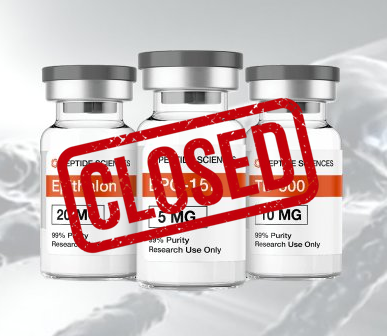
No.
Peptide Sciences’ official website currently states that the company voluntarily shut down operations and discontinued sales of its research products.
The site no longer functions as the active peptide storefront that longtime customers may remember.
The current situation can be summarized simply:
- Peptide Sciences has stopped selling research products
- The company describes the shutdown as voluntary
- No reopening date has been announced
- No official successor company has been announced
- The Peptide Sciences brand and intellectual property remain controlled by the original company
- The company warns customers about websites claiming to be affiliated with it
That final point is especially important.
Peptide Sciences now says that any website, platform, company, or individual claiming to be affiliated with the company, claiming to be its successor, or claiming to sell its products without authorization should not be treated as Peptide Sciences.
So if you encounter a new site claiming that “Peptide Sciences is back,” I would be extremely cautious.
Who Was Peptide Sciences?
Peptide Sciences was a U.S.-based chemical supplier specializing in peptides and related research compounds intended for laboratory and in-vitro research.
For years, it was one of the most visible companies in the research peptide market.
The company distinguished itself through:
- A very large peptide catalog
- Research-use-only positioning
- Batch-specific Certificates of Analysis
- HPLC and other analytical testing
- Domestic U.S. fulfillment
- Fast shipping on many orders
- A long operating history compared with newer peptide suppliers
Peptide Sciences repeatedly stated that its products were intended for laboratory research rather than human, medical, diagnostic, or veterinary use.
Its size and longevity made it a benchmark against which many newer peptide companies were compared.
That is also why its abrupt disappearance generated so much attention in the peptide community.
Why Did Peptide Sciences Shut Down?
The most accurate answer is: Peptide Sciences has not publicly disclosed a specific reason.
Its official closure notice says the company made the decision voluntarily, but it does not explain what ultimately caused that decision.
A March 2026 analysis from LumaLex Law, which works with businesses in the peptide industry, likewise noted that there was no confirmed public explanation for the shutdown.
There are several reasons people have speculated about, including:
- Increasing FDA scrutiny of research peptide vendors
- Greater regulatory attention surrounding GLP-1-related compounds
- Banking and payment-processing difficulties within the peptide industry
- The legal risks associated with operating a large research-chemical business
- Broader changes occurring throughout the peptide market
Those are reasonable areas of discussion because other peptide companies have faced regulatory and payment-processing problems.
But they are still possible explanations rather than a confirmed explanation from Peptide Sciences.
I therefore would not state that the FDA shut Peptide Sciences down, that a particular lawsuit forced it to close, or that one specific quality-control problem caused the shutdown unless evidence supporting that claim emerges.
What we know for certain is much simpler:
Peptide Sciences says it voluntarily shut down and discontinued the sale of its research products.
Was Peptide Sciences Legit?
Yes—in the sense that Peptide Sciences was a real, established operating research peptide supplier rather than an anonymous scam website.
Before closing, it had:
- Years of operating history
- A large active product catalog
- Published contact information
- Domestic U.S. operations
- Established shipping policies
- Batch-specific laboratory documentation
- A large customer base
- Independent testing history
I also personally ordered from the company and received my order.
That does not mean every Peptide Sciences product was automatically perfect.
There is an important difference between asking:
“Was Peptide Sciences a legitimate company?”
and:
“Did every peptide and every batch always meet expectations?”
The answer to the first question is yes.
The second question is more complicated, particularly when independent testing is considered.
My Firsthand Experience Ordering From Peptide Sciences
Because Peptide Sciences was one of the biggest names in the U.S. peptide market, I decided to place an order myself to evaluate the ordering process, pricing, shipping, packaging, and customer service.
I ordered AOD-9604.
Initially, everything went smoothly.
The order arrived quickly, and I had no complaints about the ordering or delivery process.
The problem started when I opened the package.
The vial had an unusual cloudy appearance.
It wasn’t dramatically cloudy, but it looked noticeably different from essentially every other peptide vial I had purchased over the years.
I contacted Peptide Sciences support, explained exactly what I was seeing, and sent them a clear photograph of the vial.
What Happened Next
My experience went roughly like this:
- I contacted support and explained the unusual appearance of the AOD-9604 vial
- I provided a photograph showing what I was concerned about
- Peptide Sciences initially stood by its no-return policy
- I pointed out that its policy specifically provided assistance for orders arriving with missing, incorrect, or damaged items
- The company responded that the vial had left its warehouse undamaged
- The explanation shifted toward the possibility that something had happened after shipment
- I pointed out that the vial seal had never been broken
- We exchanged several emails about the issue
- Peptide Sciences eventually agreed to let me return the vial
- I was given a return address and sent the product back
- The company ultimately refunded the product cost
- My original shipping charge was not refunded
- I also had to pay the cost of shipping the vial back
Between the original shipping charge and return postage, I believe I ended up losing roughly $20 even though the product itself was refunded.
My Takeaway From the Experience
The disappointing part wasn’t simply that I received a vial that looked unusual.
Problems can happen with any company.
What bothered me was how difficult it was to get the company to take the concern seriously despite my providing a photograph and pointing directly to the damaged-product language in its own policy.
I never claimed to know exactly what caused the cloudy appearance.
I simply did not feel comfortable accepting the vial in that condition.
Eventually Peptide Sciences did accept the return, which deserves to be acknowledged. But requiring multiple emails and leaving me responsible for shipping costs left a bad taste in my mouth.
I had essentially decided after that experience that I would avoid Peptide Sciences for future orders.
Peptide Sciences Testing and COAs
Testing was historically one of Peptide Sciences’ strongest selling points.
The company published batch-level Certificates of Analysis and promoted analytical testing as evidence of identity and purity.
Historical documentation included information such as:
- HPLC purity results
- Mass spectrometry information
- Batch or lot identification
- Peptide identity information
- Purity percentages
This was significantly more transparent than vendors that simply advertised “99% purity” without providing batch documentation.
However, vendor-published COAs are not the only testing information now available.
What Independent Testing Shows
Independent peptide-testing database Finnrick currently lists 132 tests associated with Peptide Sciences across 10 peptides.
Under Finnrick’s current purity-focused methodology:
- 132 total tests are listed
- 79 passed its classification criteria
- 53 failed
- The current overall Finnrick rating is approximately 61%
Results vary considerably depending on the peptide.
Current Finnrick scores include:
- GHK-Cu: 91%
- Semaglutide: 81%
- Ipamorelin: 78%
- PT-141: 78%
- Tirzepatide: 68%
- BPC-157: 60%
- Retatrutide: 56%
- Melanotan II: 55%
- Tesamorelin: 38%
- CJC-1295: 17%
Those figures should be interpreted carefully.
Finnrick applies its own methodology involving factors such as identity, purity, quantity, and labeling, and individual results apply to the specific samples tested rather than every vial Peptide Sciences ever sold.
Some testing dates also occur after Peptide Sciences closed. That does not mean Peptide Sciences was still selling products after the shutdown; previously purchased samples can be submitted for laboratory testing later.
Still, the database provides useful independent evidence that Peptide Sciences’ quality record was more variable by product than the company’s reputation for universally premium peptides might suggest.
🔬 How Do Current Peptide Companies Compare on Testing?
Testing and COA documentation were important parts of Peptide Sciences’ reputation. If testing transparency is one of your priorities, compare the leading active suppliers to see how their documentation, pricing, and overall offerings stack up.
Compare Testing, Pricing & More Across Our Top-Rated Companies →
What Did Peptide Sciences Sell?
Before shutting down, Peptide Sciences maintained one of the larger research peptide catalogs in the U.S.
Popular and historically available products included:
- BPC-157
- TB-500 and Thymosin Beta-4-related products
- AOD-9604
- CJC-1295
- Ipamorelin
- CJC-1295 + Ipamorelin combinations
- GHRP-2
- GHRP-6
- GHK-Cu
- PT-141
- Melanotan II
- Tesamorelin
- Epitalon
- Semaglutide
- Tirzepatide
- Retatrutide
- Numerous peptide blends and combination packages
Research Behind Some Popular Peptide Sciences Products
Several of the peptides Peptide Sciences sold have also been investigated in published scientific research, although the amount and type of evidence varies considerably by compound.
BPC-157 has been studied extensively in preclinical models involving tissue repair.
One NIH-indexed study examined its effects on tendon fibroblasts and found that BPC-157 increased cell survival and migration while influencing growth hormone receptor expression.1
These findings are interesting from a research standpoint, but they come primarily from laboratory and animal models rather than large controlled human trials.
Thymosin beta-4, the peptide commonly discussed in connection with TB-500 research, has been investigated for its potential role in tissue repair and regeneration.
A scientific review examined mechanisms involving cellular migration, inflammation, angiogenesis, fibrosis, and regenerative processes across several tissues.2
Research involving full-length thymosin beta-4 should not automatically be treated as direct evidence for every commercial product labeled TB-500.
Ipamorelin is a synthetic growth hormone secretagogue.
Published research characterized it as a potent and relatively selective GH-releasing pentapeptide.3
Its mechanism and research background are different from tissue-repair peptides such as BPC-157 and thymosin beta-4.
AOD-9604 is a synthetic analogue derived from the lipolytic region of human growth hormone.
Preclinical research investigated AOD-9604 in obese animal models and reported effects involving body-weight gain, adipose tissue, and lipid metabolism.4
This is also the peptide I personally ordered from Peptide Sciences, although the scientific research on the compound is separate from my experience with the company’s product.
CJC-1295 is a long-acting analogue of growth hormone-releasing hormone.
A controlled human study reported sustained, dose-dependent increases in growth hormone and IGF-I concentrations following CJC-1295 administration.5
GHK-Cu is a naturally occurring copper-binding peptide with a long history of regenerative and dermatological research.
Published research has examined GHK-Cu in connection with collagen and elastin synthesis, tissue remodeling, blood-vessel growth, and other regenerative processes.6
Semaglutide is a GLP-1 receptor agonist with extensive human clinical research.
In the STEP 1 randomized trial, Semaglutide was studied in adults with overweight or obesity and produced substantially greater average weight reduction than placebo over 68 weeks.7
Retatrutide is an investigational triple agonist targeting GIP, GLP-1, and glucagon receptors.
A Phase 2 trial involving adults with obesity reported substantial, dose-dependent reductions in body weight during 48 weeks of treatment.8
These studies provide scientific context for compounds that Peptide Sciences historically sold.
They do not independently verify the identity, purity, quantity, or quality of a specific Peptide Sciences vial or batch.
The size of that catalog was a major part of the company’s appeal.
Researchers looking for an unusual peptide could often find it through Peptide Sciences without having to use several different suppliers.
That catalog no longer represents products currently available for sale. The original Peptide Sciences website has discontinued sales.
Peptide Sciences Reviews and Complaints
Peptide Sciences historically had a strong reputation in many peptide communities, particularly for:
- Fast shipping
- Large product selection
- Professional packaging
- Testing documentation
- Consistent availability of hard-to-find peptides
There were negative experiences as well.
Common areas of criticism included:
- Higher-than-average pricing
- A strict return policy
- Customer-service disputes
- Individual complaints about particular products or batches
- Mixed independent laboratory results for certain peptides
My experience falls somewhere in the middle.
The transaction itself was legitimate, the package arrived quickly, and the company eventually refunded the cost of the AOD-9604.
But I was not happy with the way the complaint was initially handled or with being left responsible for shipping costs.
That is why I would describe my personal experience as mixed to negative rather than completely negative.
What I Liked and Didn’t Like About Peptide Sciences
What I Liked
- Extremely large peptide selection
- Long history in the research peptide market
- Fast shipping on my order
- Batch-specific COA documentation
- Detailed product pages
- Strong brand recognition
- Large amount of historical testing information
What I Didn’t Like
- Premium pricing compared with many competitors
- My AOD-9604 vial arrived looking unusual
- Customer service initially refused my return
- The return required several emails to resolve
- Original shipping was not refunded
- I had to pay return shipping
- Independent testing showed inconsistent results for some products
- The company is now closed
Can You Still Buy Peptide Sciences Products?
No legitimate new Peptide Sciences products should currently be available directly from the original company.
Peptide Sciences says it has discontinued sales.
More importantly, its current website specifically warns that:
- It has not authorized a successor
- It has not authorized another company to use its name or branding
- Sites claiming affiliation with Peptide Sciences are unauthorized
- Entities claiming to sell Peptide Sciences products should not be assumed to represent the original company
This means I would be extremely skeptical of any website advertising itself as a new version of Peptide Sciences.
The safest way to verify the status of the company is to go directly to PeptideSciences.com and read the company’s current notice.
What Are the Best Peptide Sciences Alternatives?
The closure obviously creates a problem for researchers who previously relied on Peptide Sciences because few suppliers combine the same catalog size, testing history, and long-term brand recognition.
Rather than turning this review into another full supplier comparison, I maintain a separate guide specifically for that question.
See:
Peptide Sciences Alternatives: 3 Best Options for 2026
When comparing a replacement supplier, I would pay particular attention to:
- Batch-specific third-party testing
- Current COAs rather than generic certificates
- Measured quantity as well as purity
- Company operating history
- Product availability
- Shipping speed
- Customer-service reputation
- Return and damaged-product policies
- Payment-method reliability
- Independent testing outside the vendor’s own website
The Peptide Sciences shutdown is also a reminder not to rely too heavily on a single supplier simply because it has been around for years.
Even one of the biggest names in the industry can disappear.
Final Verdict: Was Peptide Sciences a Good Company?
Peptide Sciences was unquestionably one of the most established and recognizable research peptide suppliers in the United States.
It had a massive catalog, extensive testing documentation, fast fulfillment, and a long operating history.
But my own experience wasn’t as positive as the company’s reputation might suggest.
My AOD-9604 order arrived quickly, but the unusual appearance of the vial and the subsequent customer-service dispute were frustrating enough that I had already decided not to order from Peptide Sciences again.
Independent testing also adds important context. Peptide Sciences performed well on some compounds but substantially worse on others, reinforcing why I don’t think any supplier should receive a blanket assumption of quality across its entire catalog.
Today, however, the most important fact is much simpler:
Peptide Sciences is closed and no longer sells research products.
The company has not publicly disclosed a confirmed reason for the shutdown, and I would be skeptical of anyone claiming to know exactly why it happened without evidence.
I would also avoid websites claiming to be a successor or claiming to sell new Peptide Sciences inventory because the company itself says those businesses are unauthorized.
If you previously used Peptide Sciences and are looking for another supplier, see our updated guide to the best Peptide Sciences alternatives.
🏆 So Where Should You Look Instead?
Peptide Sciences may have earned a solid reputation during its years in business, but it is no longer an option for new orders. If you’re deciding where to go instead, compare the peptide companies we currently rate highest side-by-side.
Frequently Asked Questions About Peptide Sciences
Is Peptide Sciences still in business?
No.
Peptide Sciences’ official website states that the company voluntarily shut down operations and discontinued the sale of its research products.
When did Peptide Sciences close?
Peptide Sciences shut down in March 2026. The current official closure notice does not give a specific date.
Why did Peptide Sciences shut down?
Peptide Sciences has not publicly disclosed a specific reason.
The company describes the shutdown as voluntary. Regulatory pressure, banking challenges, and changes affecting the broader peptide industry have all been discussed as possible factors, but none has been publicly confirmed by Peptide Sciences as the reason for its closure.
Did the FDA shut down Peptide Sciences?
I found no public evidence establishing that the FDA directly ordered Peptide Sciences to shut down.
The company itself describes the closure as voluntary, and no confirmed public explanation has been provided.
What is the official Peptide Sciences website?
The official domain remains PeptideSciences.com.
The website currently displays the company’s shutdown notice rather than its previous active product catalog.
Is Peptide Sciences legit?
Peptide Sciences was a legitimate operating research chemical supplier with years of history, a large catalog, established customer-service channels, and extensive testing documentation.
I personally placed an order with the company and received it.
The business has since voluntarily shut down.
Can you still order from Peptide Sciences?
No. Peptide Sciences has discontinued the sale of its research products.
The company also warns that businesses claiming to be successors or claiming authorization to sell Peptide Sciences products are not affiliated with the original company.
Is there a new Peptide Sciences website?
Peptide Sciences has not announced an authorized successor website.
The company explicitly warns that websites or entities claiming to be successors or claiming affiliation with Peptide Sciences are unauthorized.
Will Peptide Sciences reopen?
There has been no public announcement that Peptide Sciences plans to reopen.
Until the company itself says otherwise, I would treat the shutdown as indefinite rather than assume the business is coming back.
Was Peptide Sciences third-party tested?
Peptide Sciences historically published batch-specific analytical documentation and COAs.
Independent testing database Finnrick also currently tracks 132 Peptide Sciences samples across 10 peptides, with results varying significantly by product.
What happened to Peptide Sciences products after the shutdown?
The original company discontinued sales.
Previously purchased products can obviously still exist in customer or laboratory inventory, but Peptide Sciences says third parties claiming to sell its products or operate as its successor are unauthorized.
What are the best Peptide Sciences alternatives?
There are several active research peptide suppliers with published testing documentation and established U.S. operations.
See our complete Peptide Sciences alternatives guide for our current comparison.
References:
-
Chang CH, Tsai WC, Hsu YH, Pang JH. Pentadecapeptide BPC 157 enhances the growth hormone receptor expression in tendon fibroblasts. Molecules. 2014;19(11):19066-19077. doi:10.3390/molecules191119066. (https://pmc.ncbi.nlm.nih.gov/articles/PMC6271067/)
-
Maar K, Hetenyi R, Maar S, et al. Utilizing developmentally essential secreted peptides such as thymosin beta-4 to remind the adult organs of their embryonic state—new directions in anti-aging regenerative therapies. Cells. 2021;10(6):1343. doi:10.3390/cells10061343. (https://pmc.ncbi.nlm.nih.gov/articles/PMC8228050/)
-
Raun K, Hansen BS, Johansen NL, et al. Ipamorelin, the first selective growth hormone secretagogue. Eur J Endocrinol. 1998;139(5):552-561. doi:10.1530/eje.0.1390552. (https://pubmed.ncbi.nlm.nih.gov/9849822/)
-
Ng FM, Sun J, Sharma L, Libinaka R, Jiang WJ, Gianello R. Metabolic studies of a synthetic lipolytic domain (AOD9604) of human growth hormone. Horm Res. 2000;53(6):274-278. doi:10.1159/000053183. (https://pubmed.ncbi.nlm.nih.gov/11146367/)
-
Teichman SL, Neale A, Lawrence B, Gagnon C, Castaigne JP, Frohman LA. Prolonged stimulation of growth hormone and insulin-like growth factor I secretion by CJC-1295, a long-acting analog of GH-releasing hormone, in healthy adults. J Clin Endocrinol Metab. 2006;91(3):799-805. doi:10.1210/jc.2005-1536. (https://pubmed.ncbi.nlm.nih.gov/16352683/)
-
Pickart L, Margolina A. Regenerative and protective actions of the GHK-Cu peptide in the light of the new gene data. Int J Mol Sci. 2018;19(7):1987. doi:10.3390/ijms19071987. (https://pmc.ncbi.nlm.nih.gov/articles/PMC6073405/)
-
Wilding JPH, Batterham RL, Calanna S, et al; STEP 1 Study Group. Once-weekly semaglutide in adults with overweight or obesity. N Engl J Med. 2021;384(11):989-1002. doi:10.1056/NEJMoa2032183. (https://pubmed.ncbi.nlm.nih.gov/33567185/)
-
Jastreboff AM, Kaplan LM, Frías JP, et al. Triple-hormone-receptor agonist retatrutide for obesity: a phase 2 trial. N Engl J Med. 2023;389(6):514-526. doi:10.1056/NEJMoa2301972. (https://pubmed.ncbi.nlm.nih.gov/37366315/)