★★★★★
3.8/5
Ion Peptide, often searched for as Ion Peptides, is one of the more unusual peptide companies we’ve reviewed recently. On the surface, it looks like a modern research peptide supplier with a polished website, a large catalog, public COAs, detailed policies, and a very strong compliance-first presentation.
But the user experience is a little different from most peptide vendors.
Unlike many companies where you can browse the full catalog immediately, Ion Peptide requires you to register an account before you can properly view its product line. That is not automatically a bad thing. In fact, it may be part of the company’s attempt to screen buyers and reinforce its research-use-only positioning. But it does create a hurdle, especially because the registration process can be finicky. In our experience, the account form took several attempts before it finally went through.
That makes Ion Peptide a mixed but interesting company to review. On one hand, the company appears to have a very large product selection, public lab testing documentation, multiple shipping methods, mainstream payment options, and detailed legal/compliance pages. On the other hand, the gated catalog and clunky registration process may frustrate people who simply want to browse products, compare pricing, and move on.
In this Ion Peptides review, we’ll look at the company’s product line, testing, registration process, shipping, payment options, refund policy, customer experience, pros and cons, and whether Ion Peptide looks legitimate overall.
Big Picture Summary 📌
- Official Brand Name: The site appears to use Ion Peptide, although many people search for Ion Peptides 🧪
- Catalog Access: You need to register an account before viewing the full product line 🔐
- Registration Experience: Account creation can be finicky and may take multiple attempts ⚠️
- Product Selection: Large catalog covering peptides, blends, drops, GLP-style compounds, topicals, and research-related supplies 📦
- Testing: Ion Peptide publishes a large COA/lab-results library and says batches are tested with UPLC/MS 🔬
- Shipping Options: Checkout offers UPS/FedEx 2–5 business days, FedEx Overnight, and FedEx Priority Overnight 🚚
- Payment Options: Accepts credit cards, ACH, Apple Pay, and Google Pay 💳
- Compliance Focus: The site has detailed RUO, compliance, community guidelines, and misuse-prevention language 🧾
- Refund Policy: Returns are limited to unopened, unused products in original packaging with intact security seals 🔒
- Best For: Researchers who do not mind registering first and want a compliance-heavy vendor with a large catalog 🧬
- Potential Drawback: The buying process is less frictionless than many competitors because the catalog is gated behind account registration 🚧
- Important Note: Products are sold strictly for research use only and are not intended for human or animal consumption 🚫
Who Is Ion Peptide? 🏢
Ion Peptide is an online research peptide supplier that sells laboratory-use compounds through IonPeptide.com. The company presents itself as a research-only business rather than a wellness, supplement, cosmetic, or clinical-use brand.
The company’s website is noticeably compliance-heavy. It has dedicated pages for Compliance & Legal Overview, Community Guidelines, Research Use Only Policy, Shipping Policy, Refund Policy, and COA/lab results. That is more formal documentation than you see from many peptide companies, especially smaller vendors that only provide a homepage, product pages, and a short disclaimer in the footer.
Ion Peptide also lists business/contact information on its site. Publicly visible pages reference entities such as Great Research LLC and Ion Research LLC, along with multiple mailing or business addresses. However, the company does not appear to prominently list an individual owner, founder, or executive team. That means Ion Peptide is more transparent than some vendors at the business-entity level, but still not fully transparent at the personal ownership level.
The most important thing to know from a buyer’s perspective is that Ion Peptide is not built like a normal open catalog. You can view general pages, policies, and lab results publicly, but to access the full product lineup and shop properly, you need to create an account.
That gives the site a more controlled, research-gated feel. Some researchers may appreciate that because it signals a stricter compliance posture. Others may find it inconvenient, especially if they are just trying to compare products and prices quickly.
Account Registration Experience 🔐
One of the biggest practical differences with Ion Peptide is that you must register an account to view the full product catalog.
This is worth emphasizing because it affects the entire shopping experience. Most peptide companies, including popular ones like Solution Peptides and Apex Peptides, allow visitors to browse products immediately. Ion Peptide takes a more restricted approach, which may be designed to limit casual browsing, reduce misuse, and keep the site aligned with its research-use-only policies.
The downside is that registration is not as smooth as it should be. In our experience, the form was finicky and took several tries before the account was successfully created. That does not necessarily reflect the quality of the products, but it does affect first impressions.
For a company that appears to be trying hard to look professional and compliance-focused, a clunky registration process is a real usability drawback. Researchers who are already familiar with the company may not care much, but first-time visitors may find it frustrating.
The positive side is that once you get through registration, the product selection is much more visible. The full shop appears to be extensive, with far more products than you can evaluate from the public-facing pages alone.
Is Ion Peptides Legit? ✅
Based on the available information, Ion Peptide appears to be a legitimate research peptide supplier, but it is not the most frictionless company to use.
The legitimacy case is fairly strong. Ion Peptide has a large product catalog, public lab results, detailed compliance pages, contact information, shipping policies, return policies, and a strong emphasis on research-use-only restrictions. The company also states that its products are tested using UPLC/MS methods, and its COA page includes a long list of products and batch documentation.
The compliance side of the website is especially notable. Ion Peptide repeatedly states that its products are for laboratory research and analytical purposes only. Its Research Use Only policy says products are not for human or animal use, not for medical use, and not intended as foods, drugs, supplements, cosmetics, or household items.
The company’s Community Guidelines page also reinforces this positioning. It prohibits dosage advice, human-use discussion, misuse, misleading claims, and creator/influencer affiliation claims. That makes Ion Peptide feel more guarded than many peptide companies, but it also makes the brand seem more intentional about staying inside research-only boundaries.
That said, there are a few caveats.
First, account registration is required to view the full catalog, and the registration process can be annoying. Second, ownership transparency is still limited because individual owners are not prominently named. Third, even though the company provides COAs, researchers should still verify each product’s batch-specific documentation before purchasing. Fourth, the company’s strict compliance posture may be a positive for some researchers but a turnoff for buyers who prefer a simpler browsing experience.
Overall, Ion Peptide looks legitimate, but it is best described as a high-compliance, gated-access peptide supplier rather than a casual open storefront.
Ion Peptides Product Line 🧬
Ion Peptide has a much larger product catalog than you can see at first glance, but there is one catch: you need to create an account before you can properly view the full product line. Once logged in, the shop opens up into a pretty extensive catalog that includes classic research peptides, peptide blends, GLP-style compounds, drops, topicals, and other specialty research products.
Some of the more popular ones include:
- BPC-157
- TB-500
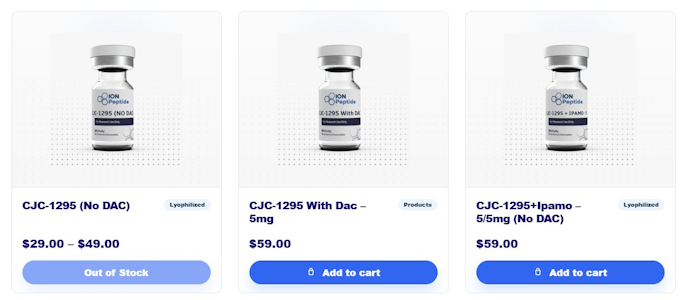
- CJC-1295
- Ipamorelin
- GHK-Cu
- KPV
- IGF-LR3
- AOD-9604
- Cagrilintide
- ION-2T
- ION-3R
Let’s briefly go over each of these to give you a sense of how they work and what they are typically researched for.
BPC-157 🩹
BPC-157 is one of the most popular research peptides in the entire peptide space, and it is a core product in Ion Peptide’s catalog. It is commonly studied for its potential role in tissue repair, gut-related research, tendon and ligament models, inflammation response, and wound-healing pathways.
TB-500 💪
TB-500 is another major peptide in Ion Peptide’s product lineup and is often discussed alongside BPC-157. Researchers often study TB-500 in connection with soft-tissue repair models, flexibility, mobility, inflammation response, and recovery pathways. Like most peptides in this category, the strongest claims are still based on laboratory, animal, or early-stage research rather than broad clinical confirmation.
CJC-1295 📈
CJC-1295 is a growth hormone-releasing hormone analog that is typically researched for its interaction with the GH/IGF-1 axis. In research settings, it is often discussed in relation to growth hormone pulse signaling, body composition models, recovery pathways, sleep-related research, and age-related endocrine changes.
Ipamorelin ⚡
Ipamorelin is a growth hormone secretagogue that is commonly researched for its selective stimulation of growth hormone release. Researchers typically study it in relation to recovery, lean tissue models, body composition, sleep quality, and growth hormone signaling. It is also frequently paired with CJC-1295 because CJC-1295 may support upstream GH release while Ipamorelin may help stimulate GH pulses through ghrelin receptor activity.
GHK-Cu 🧴
GHK-Cu is a copper peptide that is commonly researched for skin, collagen, wound-healing, and tissue-remodeling pathways. Ion Peptide appears to carry GHK-Cu in several formats, which makes it one of the more flexible categories in the catalog. However, researchers should be careful not to treat cosmetic-style marketing around copper peptides as a substitute for batch-specific testing and research-use documentation.
KPV 🔥
KPV is a small peptide fragment derived from alpha-MSH and is often studied for its potential anti-inflammatory properties. It is commonly discussed in relation to gut inflammation models, immune signaling, skin-related research, and inflammatory pathway regulation. Within Ion Peptide’s catalog, KPV may appeal most to researchers focused on inflammation, immune response, and gut-related research rather than growth hormone or performance pathways.
IGF-LR3 🧬
IGF-LR3 is a modified version of insulin-like growth factor 1 that is commonly researched for its longer activity profile compared to standard IGF-1. It is often discussed in relation to cell growth, anabolic signaling, recovery models, nutrient partitioning, and muscle tissue research.
AOD-9604 ⚖️
AOD-9604 is a peptide fragment derived from the C-terminal portion of human growth hormone and is commonly discussed in metabolic research. It is often studied in relation to fat metabolism, lipolysis models, weight-regulation pathways, and body composition research.
Testing & COA Transparency 🔬
Testing is one of Ion Peptide’s strongest selling points.
The company maintains a large public lab-results section with a long list of products and batch documents. Ion Peptide states that batches undergo UPLC/MS testing to confirm purity, strength, and impurities. Its FAQ also mentions third-party laboratory testing and analytical methods such as HPLC, LC-MS, NMR, FTIR, GC-MS, ICP-MS, UV-Vis spectroscopy, and other methods depending on the compound.
This level of documentation is above average for the peptide industry. Many peptide vendors claim “99% purity” without giving researchers an easy way to verify batches. Ion Peptide makes COA access much more central to the website.
That said, researchers should still use the COA library properly. A COA is most valuable when it is recent, product-specific, batch-specific, and easy to match to the vial being purchased. A large lab-results page is helpful, but buyers still need to check the exact product and batch rather than assuming all products are equally documented.
Overall, Ion Peptide performs well on testing transparency compared to many peptide suppliers.
Shipping, Payment & Checkout Experience 🚚
Ion Peptide’s checkout process is one of the areas where the company feels more modern than many peptide vendors.
After account registration, the checkout appears to offer three shipping options:
- UPS / FedEx 2–5 business days 📦
- FedEx Overnight 🚚
- FedEx Priority Overnight ⚡
The company’s shipping policy also emphasizes same-day processing for qualifying orders placed before the cutoff time on business days. Free 2-day FedEx/UPS shipping may be available on domestic U.S. orders over $250, depending on checkout conditions.
The payment options are also better than many peptide companies. Ion Peptide accepts:
- Credit cards 💳
- ACH bank transfer 🏦
- Apple Pay 🍎
- Google Pay 📱
This is a major plus. Many peptide vendors rely on less convenient payment methods because payment processors can be difficult in this industry. The fact that Ion Peptide supports mainstream options like credit cards, Apple Pay, and Google Pay makes checkout easier once you get past the account registration step.
The overall checkout experience is therefore a bit of a tradeoff. Registration is frustrating, but payment and shipping options are relatively strong.
Customer Reviews & Feedback ⭐
Ion Peptide appears to have a stronger public review footprint than many smaller peptide vendors. Customer feedback generally highlights fast shipping, responsive support, product satisfaction, and repeat orders.
The positive themes are easy to understand. Ion Peptide offers a large catalog, public testing documentation, multiple payment options, and fast shipping choices. Those are all things researchers tend to care about.
However, the company is not perfect. Some buyers may dislike having to register before browsing products. Others may be frustrated if the registration form does not work smoothly the first time. There may also be confusion around shipping timelines, especially because checkout options and policy language can vary depending on service, location, carrier, and order timing.
The other thing to note is that Ion Peptide appears to take misuse and compliance very seriously. Its FAQ and policies mention blacklisting, zero-tolerance rules, and limits on support. That means customers should not expect dosing, preparation, administration, or human-use guidance.
For serious research buyers, that may be reassuring. For casual shoppers, it may feel restrictive.
Pros and Cons ⚖️
Pros ✅
- Large and diverse product catalog 📦
- Public COA/lab-results library 🔬
- UPLC/MS testing claims and third-party testing language 🧾
- Strong compliance and research-use-only documentation 🛡️
- Multiple shipping options at checkout 🚚
- FedEx Overnight and FedEx Priority Overnight available ⚡
- Accepts credit cards, ACH, Apple Pay, and Google Pay 💳
- Free shipping threshold available on qualifying domestic orders 💰
- Detailed refund, shipping, community, and RUO policy pages 📄
- Carries classic peptides, blends, GLP-style compounds, drops, and specialty formats 🧬
- More professional policy structure than many peptide vendors 🏢
Cons ⚠️
- Must register an account to view the full product catalog 🔐
- Registration process can be finicky and may take multiple attempts 🚧
- Individual ownership details are not prominently listed 👤
- Refunds are limited to unopened, unused products with intact seals 🔒
- Large catalog may feel overwhelming once unlocked 📦
- Some product formats may not appeal to vial-only researchers 💧
- GLP-style products require extra COA and identity verification ⚖️
- Compliance-heavy tone may feel restrictive to casual buyers 📋
- No dosing, administration, preparation, or human-use support is provided 🚫
Frequently Asked Questions ❓
Does Ion Peptides have a coupon code? 🏷️
Ion Peptide appears to run promotions from time to time, and the site may display sale banners or discount codes depending on when you visit.
The company also has a pricing structure that may include product-level discounts or bulk purchasing incentives. Since the catalog is gated behind account registration, the best way to confirm current coupon codes is to register, log in, check the homepage/banner area, and review the cart before checkout.
Because peptide discount codes change frequently, it is better to verify active promotions directly on the site rather than relying on old coupon pages.
Are their peptides 3rd party tested? 🧾
Yes, Ion Peptide states that its products are third-party tested and provides a large public COA/lab-results library. The company references UPLC/MS testing and other analytical methods depending on the compound.
This is one of Ion Peptide’s stronger features. The COA library is extensive and easier to access than what many peptide vendors provide.
That said, researchers should still verify the specific COA for the exact product and batch they are ordering. A public testing page is useful, but batch-specific verification is still important.
What is Ion Peptides pricing like compared to the competition? 💰
Ion Peptide appears to be priced in the competitive middle of the research peptide market.
It is not positioned like a bargain-basement peptide supplier, but it also does not look like the most expensive premium vendor. Pricing varies widely depending on the product, size, format, and category. Classic peptides are generally more affordable, while GLP-style compounds, specialty products, larger vials, and alternative formats tend to cost more.
The biggest pricing advantage is that Ion Peptide combines a large catalog, visible COAs, mainstream payment options, and fast shipping methods. For researchers who value documentation and checkout convenience, that may justify the pricing. For buyers who only want the absolute cheapest vial, there may be lower-cost competitors.
Overall, Ion Peptide is best described as mid-market to slightly premium, depending on the product.
Conclusion 🏁
Ion Peptide is a legitimate-looking, compliance-heavy research peptide supplier with a large catalog, public COAs, multiple shipping methods, and strong payment flexibility. The company stands out for its lab-results library, detailed RUO policies, and checkout options like credit cards, ACH, Apple Pay, and Google Pay.
The biggest drawback is access. You need to register before viewing the full catalog, and the registration process can be finicky. That adds friction compared to peptide companies that let visitors browse immediately.
Overall, Ion Peptide is worth considering for researchers who want broad product selection, visible testing documentation, and a more controlled research-only buying environment. It may not be the best fit for people who want a quick, open browsing experience, but for buyers willing to get through registration, the company offers one of the more extensive and compliance-focused peptide catalogs currently available.
As always, Ion Peptide products are intended strictly for research use only and are not for human or animal consumption.